
Lake Haven Self Help for Dogs
Because there are many techniques that can be used for changing a dogs behavior these pages can only act as guidelines as to what might work for your pet. Getting professional support is always best but these tips have proven to be effective for many people. And always remember; "Your dog will respond quickly and become a happy contented pet if you reward them for doing what you want instead of punishing them for doing what you don't want." Most Common Concerns
|
| Fear/Nervous Aggression Territorial Aggression Predatory Aggression Sexual Aggression |
Dominance Aggression Learned Aggression Protective Aggression |
So remember, that dog aggression is a complex canine behavioral problem, with each case requiring serious attention. It can stem from many and varied causes and can surface at any time throughout your dog's life. Dog on dog aggression if left untreated will only escalate and become worse. It won't just disappear without your intervention.
 About Dog On Dog Aggression
Your first course of action should be a visit to your Veterinarian to rule out any medical reasons for the aggressive behavior (don't just rule this out yourself).
If you can't control your dog's aggression then seek out the expertise of an experienced animal behavior specialist. This applies to all forms of dog aggression - it's just too serious to take lightly.
Attend proper obedience training classes because obedience training establishes you as a fair and trusted leader and improves communication between handler and dog. It also means you will have voice control over your dog in any situation.
If you have a puppy then early socialization is a crucial stage for it to go through. Letting your dogs learn how to interact with each other is an essential step in the prevention of dog to dog aggression.
Each time you let your dog get away with aggressive behavior you are actually rewarding so don't reinforce the unwanted behavior.
Don't add punishment or pain such as leash corrections or electronic shock collars to an already fired up and stressed dog is a very risky action to take. There's far more effective and humane training methods we can implement instead. Remember; "Your dog will respond quickly if you reward him for doing what you want instead of punishing him for doing what you don't want."
The earlier you recognize and take proper action against the aggression the better. Remember that dog to dog aggression is never acceptable and you must make it crystal clear to your dog on every occasion it occurs.
Head collars and a muzzle are an effective tool to prevent altercations and may help but they don't get to the root of the problem. They are not the ultimate solution.
Never comfort your dog when he/she displays aggression - this sends the wrong message and actually rewards the behavior. As we know behavior that we reward is highly likely to be repeated.
How To Stop Or Control On Leash Dog Aggression
 One of the most common times your dog displays
aggression towards other dogs is when you are out enjoying your
daily walk. Lets have a look at some of the steps you can take to
control your dog's on leash frustration.
One of the most common times your dog displays
aggression towards other dogs is when you are out enjoying your
daily walk. Lets have a look at some of the steps you can take to
control your dog's on leash frustration.
Once again obedience training is the key. At the first sign of any anxious or aggressive behavior from your dog you can immediately call on an obedience command such as a down-stay to divert his/her attention. You are asking your dog to perform an alternate behavior which takes his focus and attention away from the other dog. It also changes your dogs body language to a passive, non threatening posture.
When you are in the process of eradicating on leash aggression be sure to use a suitable muzzle and do your best to avoid possible confrontations. This won't fix the problem but it's a worthwhile temporary measure.
Always be mindful that your dog is very sensitive to your energy, emotions, breathing and feelings. Therefore if you tense up and grab hold of the leash tightly at the first sign of an approaching dog, your dog will pick up on this and become anxious and stressed. This is a huge factor in most cases of on leash aggression.
You want your dog to believe that other dogs are no big deal rather than something to get worked up about. Another reason to not tighten up the leash is because this changes your dog's body language (makes your dog stand upright and tall). This can be seen by the other dogs as a show of dominance or at the very least threatening.
Another technique is to play the "find it" game. This redirects your dog's attention, breaks eye contact with any other dogs and produces non threatening body language from your dog. All you need to do is throw a treat on the ground and say "find it". Your dog will pick this game up very quickly and is sure to love it.
As with teaching any new command start in a familiar environment to your dog, free from any distractions DO NOT start teaching this attention exercise when you are out and about on your walk.
This exercise is all about getting and holding the attention of your dog, so grab a handful of your dogs favorite treats and lets get started!
With your dog on leash say "Toby" (your dogs name) "look", as soon as your dog looks up at you (gaining eye contact) praise him/her and then produce the treat from your pocket and give it. Remember to keep this sequence the same every time "Toby look!, as soon as you gain eye contact immediately praise your dog "good boy!", then provide the treat.
Build on this training by adding some variables such as saying "Toby look!" then take a couple of steps to one side. When your dog follows you and looks up to make eye contact you praise and produce the yummy treat. Now you can lengthen the amount of time you have your dog's attention by repeating this exercise back to back. It goes like this, say "Toby look!" take a couple of steps to your right, your dog follows you and looks up into your eyes, you praise and then treat. Straight away you repeat this process (step to the left this time) and continue to do it 5 or 6 times.
Keep practicing this exercise over and over and take it to different locations and gradually add some distractions such as the presence of other dogs. This may take a while, take it slow!
Always reward your dog for polite, calm greetings with unfamiliar dogs. Demonstrate to your dog that you are happy with him/her.
Dog to dog aggression can be a sign of of dominance so here are ten rules to control dominance in a dog:
Engage in consistent (daily) non-confrontational obedience training with an appropriate reward for a job well done.
Require all food and treats to be earned by having the dog sit or lie down on command before they are made available.
Have the dog work to receive petting (obey a command).
Initiate and terminate all games, using one-word commands.
Store all toys and other objects the dog is likely to steal and only provide them under certain terms and conditions.
Do not supply real bones, rawhide chews, or delicious foods that the dog might want to protect.
Do not force a dominant dog to do anything.
Never reprimand the dog but rather ignore it, turning a cold shoulder when it behaves badly.
Prevent the dog from getting onto furniture or beds. Over time it can be allowed but only when the dog is invited.
Provide adequate exercise and a low-protein diet that is free of artificial preservatives.
Does your dog have separation
anxiety?

Much of what is
called "separation anxiety" is really boredom, or the dog
discovering the chance to engage in his favorite "hobbies" safely.
If your dog spends every second that you're home glued to your side,
including sleeping times, and any destruction you find happens
within the first 20 minutes of your absence (use a video camera to
watch, or come back within a short time period) then it's possible
that you have a true case of separation anxiety. If your dog can
spend the night away from you, and is comfortable being somewhat
separated from you while you're home, you probably do not really
have separation anxiety - you are more likely to be dealing with
boredom or just inappropriate chewing, barking, digging, etc.
It is likely to
be separation anxiety if:
The
dog chews on a variety of things, but chewing is often focused on
items that smell most like you (or a particular person in your
house) such as recently discarded clothes, including underwear or
socks, or favorite chairs; and /or escape routes (doors or windows).
The dog only chews these items when you're gone.
The
dog tries to stay close to the things that smell most of you (chewed
stuff will still be warm when you get home)
The
dog pees or poops inappropriately, sometimes in many locations.
The
dog barks continuously during the day, perhaps after a build-up of
whining. The barking is not on-off-on-off.
The
dog always shows these behaviors when left alone, even for short
periods (30 minutes or less).
The
dog is wild to greet you, and is still stressed, anxious and clingy
when you first arrive home.
The
dog does not appear "guilty" over destroyed items.
Destruction begins soon after you leave; or possibly again shortly
before you come home.
The
dog cannot be isolated from you at any time, even in a different
room with the door closed.
The
dog sleeps with you. (This does not mean that all dogs who sleep
with their owners will get separation anxiety. It does mean that
dogs that survive being apart from you at night can survive it
during the day, too).
Sometimes, the dog can be left alone in a car (for any length of
time) or other unusual location, without showing anxiety or
destructiveness.
Sometimes the dog can be left with anyone; sometimes it is one
particular person whose absence triggers the anxiety or issues.
The dog gets increasingly distressed as you prepare to leave.
The
dog is constantly following you and demanding your attention when
you are home.

Here are some things you can do to start the
process...
Try to make your
arrivals and departures very boring and low-key. Don't make a big
fuss over saying hello and goodbye. Be very casual and up-beat.
Try to make
interactions with your dog on your terms, not his. You pet him,
treat him, or play with him when you want, and not when he asks for
it.
Get your dog
used to your getting-ready-to-leave cues, like picking up keys and
jacket. Go through these actions repeatedly during the time when
you're staying home, without actually leaving. If your dog has
already learned to associate his fears with your departure cues, it
will take a lot of repetitions before the dog will get it.
Give your dog
more exercise. A tired dog is a good dog! A dog can sleep most of
the day if he's tired enough. Most young dogs could use 20-100
minutes of full-speed running per day. Increase your dog's exercise.
Don't forget mental exercise, like training, exploring new places,
encountering new smells, and social interaction with other dogs.
Taking your dog to a park where he can run and play with others may
be crucial.
Give your dog
something to do while you're gone! What does your dog do all day-
wait around for you to come home? Give your dog a hobby. Jean
Donaldson calls the solution to a lot of dog problems "work-to-eat"
programs. Stuff a Kong or a hollow prepared bone, fill up a Buster
Cube or Roll-A-Treat, scatter the dog's food in the grass or hide
several chew treats around the house. A dog that is working for
goodies is not barking or chewing, and a dog that is eating is not
as stressed!
Don't draw
attention to forbidden objects just before leaving - in other words,
don't straighten up or point out the items that you don't want the
dog to chew. Your dog might misinterpret your attention and give
those objects his attention just because of it. In a similar way,
punishing your dog afterwards for destruction he's done will
probably not help - it will not reduce your dog's anxiety, show him
a better way to deal with it, or give him an alternative behavior.
He might not even connect the punishment with the action he did to
cause the destruction. (Don't confuse a dog's "appeasement display",
developed to stop threats of aggression, with a "guilty look" that
implies a promise that your dog won't do it again.
Consider crating
your dog. Some dogs are more comfortable when confined to a small
"den". Make sure your dog can "hold it" for as long as you need him
to, and provide plenty of exercise so that his main activity in the
crate is sleeping. You might just want to consider leaving your dog
in one room (rather than giving him the run of the house), and maybe
leaving a radio on and an article of clothing that smells like you
in the next room. Warning: Some dogs are a lot less comfortable
confined to a crate when alone. Make sure your dog is comfortable
and secure.
Consider taking
your dog to doggie daycare or to a friend's house (or to work or on
errands with you), so that he is not actually alone, while you train
your dog to deal with being alone. Remember, dogs are pack animals
that want to be with others; being a "lone wolf" can be dangerous in
the wild, as well as lonely. Note that for many dogs who have bonded
strongly with people, having another dog (or other pet) around will
not be sufficient.
 If you have serious separation
anxiety...
If you have serious separation
anxiety...
Serious
separation anxiety is indicated by a dog who does major property
damage (chews holes through walls), injures himself in his anxiety
(scratches or rubs paws or nose raw in digging or chewing), or
stresses himself to the point of exhaustion during your absence.
While stop-gap measures, like keeping the dog with you or with
another person, will help while you train, you will need to spend a
lot of time teaching this type of dog that he can survive being
alone.
Start by making
sure your dog is getting enough exercise, including mental exercise
(usually satisfied with some training and the chance to interact
with other dogs or explore new places). Before you can retrain your
dog (and it may take weeks or longer), arrange for the dog to not be
alone - get a pet sitter, join a doggy daycare, or leave your dog
with a friend who's home all day.
Practice What You Want
Get your dog
used to being confined to a pen or room where you will eventually
leave him, even when you're home. Give him chew toys or some other
interactive toy to occupy himself with while you quietly remain near
by and ignore him. If your dog abandons the toy to try to demand
your attention, quietly get him interested in the toy again, and
quietly praise him for playing with it. Go back to ignoring him for
a very brief period, and then intermittently, quietly praise or
reward him for it. Practice this quiet confinement for a little
while, then quietly open the door or gate and go about your
business, allowing the dog to leave that area as well. This will be
your dog's "safety zone". Do NOT leave your dog in this area when
you must actually leave - for now.
Throughout your
time together, do not give in to your dog's demands for your
attention. If he comes to you whining, pawing, barking, jumping,
jumping into your lap, or rubbing up against your hand, quietly turn
away from him (you can stand up a little slowly to softly dump a
small dog out of your lap). Wait until your dog is doing something
else that is acceptable (not demanding your attention), and then
call him over for some attention. Remember, if your dog can get your
attention on demand any time you are home, it will be an even
sharper contrast when you are gone.
Some research
has suggested that this process of no longer allowing your dog on
your lap or your furniture, no longer allowing him to sleep in your
room, no longer giving treats"for free", and no longer allowing your
dog to follow you throughout the house (using doors, baby gates,
"stay" commands, etc.) may be vital for some separation anxiety
cases. You may want to try a "Nothing In Life is Free" program.
Next, pick a day
(or two) when you can practice desensitization without having to
actually leave - a weekend is a pretty good time to start.
Desensitize Your Dog To Your
Getting-Ready-To-Go Cues
Figure out what
begins your dog's anxiety. Is it when you put on your work shoes?
Brush your hair? Pick up your keys? Find the earliest item in your
getting-ready-to-go sequence that makes your dog anxious. Then
practice doing that action, over and over again, until your dog is
no longer anxious about it. For example, put on your work shoes,
then take them off, then put them on again, over and over. You don't
need to talk to your dog or do anything else special. Act just like
you do every morning when you put on those shoes. When your dog is
no longer anxious when you put on your shoes, move to the next step
in your normal morning sequence; perhaps brushing your hair. (Note
that if your dog's anxiety does not decrease after several
repetitions, you are probably not working on the first item in your
getting-ready-to-go sequence, and you'll need to back up).
Repeat this
exercise several times a day (5-10 times if possible), starting each
sequence at a time when the dog is relaxed. Do NOT repeat the
exercise if your dog seems MORE anxious when you start, or if he
can't settle down in between repetitions, or if he follows and
watches you MORE between exercises.
You will have to
spend a LOT of time with the early items in your getting-ready-to-go
sequence, but as your dog learns to deal with this sort of thing, it
will get easier. Opening up the front door (presumably the last item
in your getting-ready-to-go sequence) will take fewer repetitions
than the first item (putting on work shoes, in this example).
Practice Short-Enough Absences
When you've
worked through your whole getting-ready-to-go sequence and your dog
is no longer anxious, you're ready for your first absence session.
Up to now, your dog with separation anxiety has associated absences
with intense anxiety. The dog has to now learn to associate absences
with a lack of anxiety, or calmness. You and the dog will practice
being apart from each other for very short lengths of time - the
time that your dog can handle - and you will gradually practice
longer and longer lengths.
So you've gone
through your whole getting-ready-to-go sequence, and your dog is not
yet anxious (if your dog is anxious, you are not ready to do any
absences. Go over repeating the sequence items until your dog is
calm about them). Now you're ready for your first very short
absence. First you're going to want to give your dog some signal
that this is just a "practice session". This could involve asking
the dog to stay in a different area (such as the pen or room you
practiced in), leaving a radio on, even spraying a certain scent in
the air. This becomes a "practice cue" or a "safety cue".
Walk out the
door, shut it behind you, lock it, and then turn around, unlock it,
and come back in. Don't make a fuss over the dog. Repeat. When your
dog is not anxious, lengthen your absence to 2 seconds. Repeat until
your dog is not anxious. Lengthen your absences to 3 seconds, with
occasional 1-second absences. Repeat until your dog is not anxious.
Continue with this process, gradually increasing the length of time
you are gone. Every once in a while practice a shorter session - you
don't want the dog to learn that each absence will be longer, as
this might make him more anxious. Gradually increase the average
length of time of your absence until the dog is alone for longer
than your normal absence. (although some researchers write that two
hours is a benchmark, after which the dog may be able to handle
significantly longer time.) Yes, that means you will NOT be able to
really leave the dog alone in the "safety zone" for longer than
you've successfully practiced. Keep your dog in the old place where
you had him wait, and/or hire a dog sitter, etc.
It might help to
set up some cues that the dog will not be alone for longer than he
can handle, in other words, that this is just a practice session. Do
you normally leave the radio or TV on when you're home? If you do,
the silence when you're gone is a good indicator that the dog is
alone. During this training, set up a cue that says "this is just a
practice", such as the sound of the radio or a Mozart CD that you
leave on "repeat" on the CD player. When you really do leave, you
will continue to play this same cue - the dog will always believe
that this is just a practice session.
Note: Some
medications, such as the tricyclic antidepressants, buspirone and
benzodiazepines (possibly clomipramine hydrochloride, "Clomicalm" or
amitryptalline), may help your dog get over his anxiety. These MUST
be prescribed by a knowledgeable veterinarian. However, some of
these may take a few weeks to take effect, so you will need to make
sure the medications are in effect before you try to use them in
combination with the desensitization. The medications will not work
in the long-term without the desensitization/counter-conditioning
work - the process of teaching the dog how to deal with being left
alone.
Another thing
you might want to consider is a product which is a sort of doggy
"plug-in" called "Comfort Zone with DAP", which releases a chemical
which is supposed to be a dog comforting hormone. It often helps to
calm stressed or exited dogs down. For some "anxious dogs" it seems
to really help take the edge off of their anxiety or intensity. Some
researchers suggest that it may be as effective as clomipramine.
Homeopathic
remedies like the Bach Flower Essence mix "Rescue Remedy", may also
help calm a very anxious dog during training. You should talk to
your vet (traditional or holistic) about using these items to help.
Visit the Alternative Veterinary Medicine webpage to find a holistic
vet near you.
This is an
outline of the steps that you must go through to help your dog deal
with separation anxiety. The process takes a long time - weeks or
months - and you may find that an experienced dog trainer or
behaviorist can help the process go more smoothly and more quickly.
 My Dalmatian Harry developed separation anxiety seemingly for no
reason when he was about 7 years old. He would start digging and
crying as soon as I left the house, even if my other family members
were home.
My Dalmatian Harry developed separation anxiety seemingly for no
reason when he was about 7 years old. He would start digging and
crying as soon as I left the house, even if my other family members
were home.
The next step was to get him used to being outside while I was
inside. Again we started off with very small periods apart and
gradually lengthened the time over a couple of weeks.
If you try this Separation Anxiety in dogs treatment make sure that
you don't just leave your dog outside to get all worked up and
stressed. The trick is to start out leaving your dog out for a few
seconds, then going out and reuniting before he shows any signs of
separation anxiety. Give your dog a treat or dog toy to keep his
mind off missing you. Only initiate contact with your dog when he is
calm and quiet.
Step 3
The next step in fixing Harry's separation anxiety problem was to
eliminate the distress caused by me getting ready to leave the house
for work. What I did was write a list of all the triggers that
started Harry's anxiety. I then set about desensitizing him to these
triggers. I'd put my shoes on, and not go anywhere. Put my coat on,
then sit down to read the paper. Pick up my car keys and just carry
them around with me, jangling along as I went about my business.
After a while (about 3 weeks) Harry barely offered a sideways glance
at my shenanigans.
Step 4
When Harry was completely calm in situations that would have
unsettled him in the past, I left the house. At first I just stepped
outside, shut the door and came back inside within 20 seconds -
before he made a sound. Again this was a slow process, similar to
step 2. I extended the time outside the front door and then
graduated to starting the car, then driving around the block before
I came back inside.
You can provide a tasty treat to your dog on your way out the door,
something that he can work on for a while. Harry's favorite was a
frozen Kong stuffed full of peanut butter and a few liver treats,
this eventually kept him occupied for hours. Remember that when you
return home, don't make a huge fuss. Come inside, get changed, pour
yourself a nice hot coffee, then greet your calm dog.
This process did prove effective for me and my anxious dalmation.
All up the 4 steps took about 5 weeks to work through and fix
Harry's separation anxiety problem. My Vet suggested that I
supplement this training with some medication. I didn't go down that
path, but it would have been my next step had I required it.
 Small
Dog Syndrome is often used to describe toy breeds or any small dog
that is a nasty, snippy thing. Dog aggression issues more often than
not stem from the owners. How people act with small dogs are the
reasons so many become tiny terrors. Even worse are the owners who
laugh the behaviors off because tiny Spiffy is so funny when she
lunges after great big Uncle Joe. No matter what size a dog is, a
bite is a bite and can lead to major medical and legal issues. Even
a small dog is capable of delivering a severe bite, especially if
the victim is a child or the bite is to the face. The golden rule of
small dog ownership: if you would not allow a large dog to get away
with a behavior, neither will you allow a small dog. What can owners
do to help prevent Small Dog Syndrome?
Small
Dog Syndrome is often used to describe toy breeds or any small dog
that is a nasty, snippy thing. Dog aggression issues more often than
not stem from the owners. How people act with small dogs are the
reasons so many become tiny terrors. Even worse are the owners who
laugh the behaviors off because tiny Spiffy is so funny when she
lunges after great big Uncle Joe. No matter what size a dog is, a
bite is a bite and can lead to major medical and legal issues. Even
a small dog is capable of delivering a severe bite, especially if
the victim is a child or the bite is to the face. The golden rule of
small dog ownership: if you would not allow a large dog to get away
with a behavior, neither will you allow a small dog. What can owners
do to help prevent Small Dog Syndrome?
Realize that no matter what the size, dogs are dogs and not toys. These are not babies to be doted on with frilly clothes or treated like human infants. These are dogs and driven by the same inherent behaviors that all dogs are. Yes, there are differences in temperament breed to breed, but in general, you will see varying degrees of the same inherent behaviors in all dogs.
Small dogs are NOT fashion accessories. Sadly, too many “celebrities” own dogs as accessories and this means others will get dogs for the same reason.
Do not carry your dog all over. This can result in various behavioral issues because the dog is now unnaturally elevated. In addition, you are depriving your dog of exercise and the ability to be a dog.
 Do
not pick your dog up or allow others to without signaling the
dog. A dog who does not wish to be picked up will react. Then
when put down, he will learn that acting aggressively will stop
the humans. Teach your dog to be picked up on cue so there are
no surprises.
Do
not pick your dog up or allow others to without signaling the
dog. A dog who does not wish to be picked up will react. Then
when put down, he will learn that acting aggressively will stop
the humans. Teach your dog to be picked up on cue so there are
no surprises.
Do not allow your dog to walk all over you while you are on chairs/bed/floor nor should you give into demands for attention. All these can elevate the dog’s position above you.
Do not allow your dog to get away with snapping at people while in your lap. If this happens, DO NOT stroke your dog, you are encouraging and even praising these behaviors in a dog’s mind. Instead, give a quick “Uh! Uh!” and put the dog promptly on the floor.
Do not hand feed your dog. Unless there is a medical reason your dog has to be force fed, things like feeding your dog from your plate or only feeding your dog from your hand can add to undesired issues. Of course, your dog must learn to take treats and not to develop food aggressions, but it will not kill your dog to eat meals from a bowl.
Never put your dog on the counter or table for meals and feed from your fork. It is not natural for a dog to sit in a highchair and wear bib for meals.
Do not take size as an excuse for failing to housetrain.
Do not allow children to treat your dog like a toy, pick up, dress up like a doll or tote around. Even a small drop can cause severe damage to a tiny dog. If your child “pushes the envelope” too far with the dog, there can be a nasty nip or even a bite as a result.
If you must use clothing for your dog, make sure it is practical and properly fits. Clothes that constrain movement and are knock-offs of human clothes can cause stress which can lead to undesired reactions and behaviors. Choose clothes that allow for full free movement of legs and the ability to easily meet bodily needs.
Train for the behaviors you want from day one. And always remember; "Your dog will respond quickly and become a happy contented pet if you reward him for doing what you want instead of punishing him for doing what you don't want."
 Now,
small dogs do have special considerations. They see the world far
differently than larger dogs. Humans tend to do things with them
that they would never think of doing with a larger dog. Lie down on
the floor, look up and now have someone stand over you and act
silly. This is scary. Well this is what your dog deals with on a
daily basis. Ask people to kneel down when greeting your dog.
However, your dog must learn it is bad manners to jump into laps
without permission. Ask people not to coo or fawn all over your dog
or get the dog’s face. Do not allow them to encourage bad behaviors
like jumping or growling. Do not allow them to loom over your dog or
swoop in for a sudden pickup. It is not cute and it is a potential
lawsuit should a poorly behaving human get nipped or even bitten.
Not to mention that any work you have done could be set back.
Now,
small dogs do have special considerations. They see the world far
differently than larger dogs. Humans tend to do things with them
that they would never think of doing with a larger dog. Lie down on
the floor, look up and now have someone stand over you and act
silly. This is scary. Well this is what your dog deals with on a
daily basis. Ask people to kneel down when greeting your dog.
However, your dog must learn it is bad manners to jump into laps
without permission. Ask people not to coo or fawn all over your dog
or get the dog’s face. Do not allow them to encourage bad behaviors
like jumping or growling. Do not allow them to loom over your dog or
swoop in for a sudden pickup. It is not cute and it is a potential
lawsuit should a poorly behaving human get nipped or even bitten.
Not to mention that any work you have done could be set back.
Small dogs need not become ankle-biting menaces. If you are seeing
worrisome behaviors in your small dog, please consult with a trainer
who is familiar with the issues facing small dogs but who also knows
how to cultivate the desired behaviors you should have in any dog
regardless of size.
 Does your dog:
Get on the furniture and refuse to get off?
Nudge your hand, insisting on being petted or played with?
Refuse to come when called?
Defend its food bowl or toys from you? “Nothing in life is
free” can help.
“Nothing
in life is free” is not a magic pill that will solve a specific
behavior problem; rather it’s a way of living with your dog that
will help it behave better because it trusts and accepts you as its
leader and is confident knowing its place in your family.
Does your dog:
Get on the furniture and refuse to get off?
Nudge your hand, insisting on being petted or played with?
Refuse to come when called?
Defend its food bowl or toys from you? “Nothing in life is
free” can help.
“Nothing
in life is free” is not a magic pill that will solve a specific
behavior problem; rather it’s a way of living with your dog that
will help it behave better because it trusts and accepts you as its
leader and is confident knowing its place in your family.
How To Practice “Nothing In Life Is
Free:”
Using
positive reinforcement methods, teach your dog a few commands and/or
tricks.
“Sit,” “Down”
and “Stay” are useful commands and “Shake,” “Speak” and “Rollover”
are fun tricks to teach your dog.
Once
your dog knows a few commands, you can begin to practice “nothing in
life is free.”
Before
you give your dog anything (food, a treat, a walk, a pat on the
head) it must first perform one of the commands it has learned.
For example:
| YOU: | YOUR DOG: | ||
| Put your dog’s leash on to go for a walk | Must sit until you’ve put the leash on |
||
| Feed your dog |
Must lie down and stay until you’ve |
||
| Play a game of fetch after work | Must sit and shake hands each time |
||
| Rub your dog’s belly while watching TV | Must lie down and rollover before |
Once
you’ve given the command, don’t give your dog what it wants until it
does what you want.
If
it refuses to perform the command, walk away, come back a few
minutes later and start again. If your dog refuses to obey the
command, be patient and remember that eventually it will have to
obey your command in order to get what it wants.
Make
sure your dog knows the command well and understands what you want
before you begin practicing “nothing in life is free.”
The Benefits of This Technique:
Most dogs assume a neutral or
submissive role toward people, but some dogs will challenge
their owners for dominance.
Requiring a dominant dog to work for everything it wants
is a safe and non-confrontational way to establish control.
Dogs who may never display
aggressive behavior such as growling, snarling, or snapping, may
still manage to manipulate you.
These dogs may display affectionate, though “pushy”
behavior, such as nudging your hand to be petted or “worming”
its way on to the furniture in order to be close to you.
This technique gently reminds the “pushy” dog that it
must abide by your rules.
Why This Technique Works:
 Animals that
live in groups, like dogs, establish a social structure within the
group called a dominance hierarchy.
This dominance hierarchy serves to maintain order, reduce
conflict and promote cooperation among pack members.
In order for your home to be a safe and happy place for pets
and people, it’s best that the humans in the household assume the
highest positions in the dominance hierarchy.
Practicing “nothing in life is free” effectively and gently
communicates to your dog that its position in the hierarchy is
subordinate to yours.
From your dog’s point of view, children also have a place in this
hierarchy.
Because
children are small and can get down on the dog’s level to play, dogs
often consider them to be playmates, rather than superiors.
With the supervision of an adult, it’s a good idea to
encourage children in the household (aged eight and over) to also
practice “nothing in life is free” with your dog.
Animals that
live in groups, like dogs, establish a social structure within the
group called a dominance hierarchy.
This dominance hierarchy serves to maintain order, reduce
conflict and promote cooperation among pack members.
In order for your home to be a safe and happy place for pets
and people, it’s best that the humans in the household assume the
highest positions in the dominance hierarchy.
Practicing “nothing in life is free” effectively and gently
communicates to your dog that its position in the hierarchy is
subordinate to yours.
From your dog’s point of view, children also have a place in this
hierarchy.
Because
children are small and can get down on the dog’s level to play, dogs
often consider them to be playmates, rather than superiors.
With the supervision of an adult, it’s a good idea to
encourage children in the household (aged eight and over) to also
practice “nothing in life is free” with your dog.
This technique has also
been called
Learn To Earn which provides simmilar information on the subject.
 When you bring a dog from a breeder or shelter
into your new home, remember that to the dog, you are simply
transporting him from one kennels to another. The very first thing
you should do once you reach your home is to go for a long walk with
your dog (30 minutes to one hour) through his new neighborhood.
During this walk you are both building a bond of trust with your new
companion and establishing your position as leader. The rules of
your entire relationship are being established in those first
important moments. The dog is also getting the feeling of his new
neighborhood. You are tiring him out so he’ll be more amenable to
conditioning once you enter the house.
When you bring a dog from a breeder or shelter
into your new home, remember that to the dog, you are simply
transporting him from one kennels to another. The very first thing
you should do once you reach your home is to go for a long walk with
your dog (30 minutes to one hour) through his new neighborhood.
During this walk you are both building a bond of trust with your new
companion and establishing your position as leader. The rules of
your entire relationship are being established in those first
important moments. The dog is also getting the feeling of his new
neighborhood. You are tiring him out so he’ll be more amenable to
conditioning once you enter the house.
Entering the house is as important as the first walk together. Make sure you enter the house first. Then invite the dog in. Don’t let your husband/wife and kids come running out to shower the dog with affection and welcome him home. As hard as it will be for them, tell them to stand where they are. Bring the dog to them and let him approach them and learn their scents. All members of the family should project calm-assertive energy.
If you are bringing a dog into a new home where there in a cat or maybe two you should read the section we have on Dog & Cat Introductions. If you are bringing a dog into a home with another dog or two you should read the section on Dog to Dog Introductions and it would also be advisable to keep the new dog separate from your dog(s) for a few days to allow it to get comfortable with its new surroundings.
Avoid the temptation to let the dog roam the
house and property, sniffing out every new room and object – you are
allowing him to claim the entire property for his own. For the first
couple of weeks, you must give him “permission” to do everything. The first night, dedicate a room for him and a sleeping place,
possibly his crate or kennel. Once your dog is quiet, in his kennel,
and ready for sleep, then you can share affection and begin your
heart to heart bonding. But remember, it is not loving energy but
the energy of your leadership that will make your dog feel safe and
secure in your home.
 The next day, begin what will become your dog’s regular routine: a
long walk first thing in the morning, then food, then affection,
then rest. Introduce the dog gradually to one room at a time, always
making it clear that you are the one giving him permission to enter.
Establish early on what is off-limits and what is okay. Consistency
and strength during this early phase are gifts you are giving the
dog. You are giving the gift of a solid, reliable pack—one in which
he will soon be able to relax and become his calm-submissive self.
The next day, begin what will become your dog’s regular routine: a
long walk first thing in the morning, then food, then affection,
then rest. Introduce the dog gradually to one room at a time, always
making it clear that you are the one giving him permission to enter.
Establish early on what is off-limits and what is okay. Consistency
and strength during this early phase are gifts you are giving the
dog. You are giving the gift of a solid, reliable pack—one in which
he will soon be able to relax and become his calm-submissive self.
Remember the saying: "You never get a second chance to make a first
impression"? The idea works with dogs, too. No matter how happy you
are to bring him home, no matter how much you want to make up for
the shabby way he was treated before you got him, start him off
right from the beginning. Decide what the house rules are and stick
to them, for the first couple of months, at least. Let him know that
even though you're the nicest person on earth and the best human he
could ever hope to find, your house does have rules, and he must
follow them. Be what dog trainers call a benevolent alpha — a nice
boss, but still a boss. Your dog will understand, respect, and love
you for being his leader — it's the way dogs are. If you're not in
charge, your dog will be. No democracies here. You may want to try a
"Nothing In Life is Free" program.
Establish a routine
Most adult dogs start feeling comfortable in their new homes in
about a month. You can do a few things to help him understand that
yours is his new home and he is a loved member of his new family,
but model your leadership in front of him. Here are a few exercises
to try:
Leash-bonding. For an hour each night, attach your dog’s leash to your belt and go about your business with the other end snapped to the dog's collar. Don't call him along with you and keep your hands off the leash. Just move about your house as you normally would — putting dishes in the dishwasher, paying bills, putting in a load of wash. Don't pay the dog much mind — just let your body weight remind him that he'd better go with you. The payoff is that he learns to pay attention to where you are and to think you and what you're doing are significant.
Sit for what you want. Your dog should get in the habit of sitting for the good things. Ask him to "Sit" — and praise him when he does — before putting down his food dish, before petting him, and before letting him walk out the door on a walk. He'll start to think all good things come from you, but only when he behaves as you wish.
People first. In the dog world the higher-ranking animal goes first. You want that higher ranking animal to be you. So your dog should eat after you do, and he should walk out a door after you do. Never let him run past you — out of a car, into your yard, or into the park — as if he owns the joint. He doesn't. It's that simple.
People food, dog food. Don't share your meals with your dog, and don't add your table scraps to his. If you share, you have no one to blame but yourself for his begging.
"Oh, c'mon!" you're saying, "who died and made you a drill sergeant? I want to spoil my dog!" Sure. Later - when your dog has good house manners and you are seen as the “Alpha” or leader in your dogs eyes. Can your dog sleep on the bed? You bet! But they shouldn't come up without permission and they should know it's a privilege, not a right. Can you share your carrots sticks with them? Of course! But they should sit for them, every one. And when you tell them you're done sharing and to go to their beds, they should. Set the ground rules early and stick to them fairly and consistently. You can always loosen up, but tightening up is awfully hard after your dog's out of control.
 Excessive Barking
A dog that constantly barks can be extremely annoying - both for you and for your neighbors. All dogs bark, but when it reaches a certain stage, you need to stop dog barking before it becomes a real problem. There are a number of ways you can do this. You can buy special products that cause unpleasantness for the dog when it barks - such as dog bark collars. You can spend some time with your dog, teaching it not to bark at inappropriate times and praising it for good barking behavior. Or you can hire a special trainer who can help you control dog barking.
A barking dog does not always signify a dog barking problem. There are times when we actually want our dogs to bark - such as when an intruder enters the premises or when the family is in danger. In fact, many dogs are bred to bark in different situations in order to serve as a type of alarm.
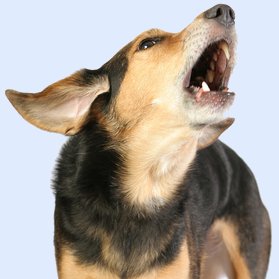 One of the other reasons a dog barks is to
communicate. A dog may bark when it wants to go outside or when it
is excited because it senses it is going for a walk. It may also
bark because it is cold, hungry, bored, anxious or excited. A dog
may bark when it sees other dogs. There are many different types of
barking that do not pose a problem - and may actually help their
owners. Before seeking to stop dog barking, you should think about
whether your dog may be trying to tell you something when it barks.
One of the other reasons a dog barks is to
communicate. A dog may bark when it wants to go outside or when it
is excited because it senses it is going for a walk. It may also
bark because it is cold, hungry, bored, anxious or excited. A dog
may bark when it sees other dogs. There are many different types of
barking that do not pose a problem - and may actually help their
owners. Before seeking to stop dog barking, you should think about
whether your dog may be trying to tell you something when it barks.
When Barking Becomes a Problem
Most owners will be prepared to accept some level of barking from
their dogs. The time when this barking becomes a problem will differ
depending on your circumstances. A person with a small baby or who
lives in an apartment will probably hope to minimize barking as much
as possible. Someone who has their dog primarily as a guard dog will
be prepared - and may even welcome - a fair amount of barking.
Different people will have different ideas about what constitutes a
dog barking problem.
Some times when owners will wish to control dog barking may include:
When it wakes the family in the middle of the night
When it annoys the neighbors
When it interrupts the family
When it breaks dog barking ordinances
When the dog seems to bark for no reason
When the dog barks at "intruders," even when these people are nowhere near the premises
When the dog barks at welcomed visitors
When the dog wakes a sleeping baby or sick
family member
Dogs do not bark excessively simply to annoy people. When dogs bark, they do not understand that they may be causing a problem. They are barking for a reason, and it is up to the owner to try and understand that reason so that the behavior can be controlled. Here are some of the reasons why a dog may bark excessively:
 They have not yet learned what is an
acceptable amount of barking
They have not yet learned what is an
acceptable amount of barking
They are anxious or bored
They have been trained to bark and believe they are doing what is required of them
They are trying to communicate with their owners and the message is not getting through
There is something causing them discomfort or fear
The first step in stopping excessive barking is to try and understand why your dog may be barking. Look at their environment and their history and see if you can identify any causes for the excessive barking. This will help you as you train your dog to control its barking. Some of the methods you can use to control dog barking include:
Remove anything that may be causing your dog discomfort or fear
Provide lots of toys and items to keep your dog amused
Spend lots of time with your dog
Ensure your dog feels safe
Understand when your dog is barking to communicate
Exercise your dog regularly
Don't reinforce anxiety barking
Remove any potential "triggers" from the dog's environment
Praise your dog for barking at appropriate times
Give your dog a treat
when it sees things that previously have made it bark (such as
visitors)
 Special Training and Products for Chronic
Barking Dogs
Special Training and Products for Chronic
Barking Dogs
For dogs that just won't stop barking, there are a number of
products and training services available to help.
Citronella Anti-Bark Collars
These collars spray the citronella scent in front of your dog's nose
when it barks. As the dog does not like the smell, it will begin to
associate barking with the unpleasant scent. You can order
citronella anti-bark collars from
Amazon.com. You can
also find these collars and similar products from pet stores.
Anti-Barking Shock Collars
These collars give the dog a shock when it barks. Many dog trainers
and vets do not like the idea of these shock collars. However,
others believe they are a good training tool if use correctly. If
you will be patient and persistent with other techniques this
approach will not be needed.
Dog Trainers
There are a number of dog trainers who will work individually with
your dog in order to control your dog's barking. These trainers will
be able to help train your dog and to give you tips for producing
the right behavior in your dog. The Association of Pet Dog Trainers
has a
Search Page that you can use to help you find a qualified
trainer.
Debarking Surgery
You might be tempted to try debarking surgery, which removes a dog's
ability to bark. However, almost all dog trainers and vets consider this
very inhumane. Barking is a dog's way of communicating to you
and each other. To remove it
would be like removing a human's ability to speak and should
therefore should not be considered.
Although dog bark collars can be very useful, they are not the best method of dog bark control. Even if it works, the reason for the dog's barking may still continue, causing anxiety and unpleasantness for your dog. If you want to stop dog barking, understand why the animal barks, remove any "triggers" and reinforce good barking behavior.
 Dog & Cat Introductions
Basics
A dog's ability to live with a specific cat does not mean that it is "good" with all cats. It may simply mean that the dog has low or no prey drive.
A dog can live with cat(s) while still maintaining prey drive around all other cats; this is because the dog considers the cat a possession or a member of the pack, (a part of the family) not prey.
 The
Keys to Success
The
Keys to Success
You will have better chance of success if your dog is a puppy. A
puppy who grows up with a cat is likely to see the cat as part of
the pack.
You will have less chance of success if:
Your dog has an aggressive or predatory nature. An aggressive dog can seriously injure or kill a cat.
Your cat is a small kitten, or is declawed, handicapped, or elderly. A kitten can be injured by an overly playful dog. Declawed, older, or handicapped cats are less equipped to defend themsleves.
Preparation steps - Important!
Get to know your dog and cat well. Be able to interpret their body language and sense their moods.
Your dog should be well-trained, and respond to commands to come, stay, and sit.
You should also know how to blend mild discipline and positive redirection to gently influence your cat's behavior.
 Before you bring the new dog home
You can ease the introduction if you do some advance preparation.
1. Make sure the cat can escape if she needs to. Cats are more
likely to be hurt by dogs than vice versa, so make sure your cat has
spots throughout the house--cleared-off countertops and shelves,
kitty condos, and so on--to leap out of harm's way.
You'll also want to create areas where the cat can get a good
distance away from the dog. You can block off rooms with baby gates,
so long as your dog can't jump over them, or install cat doors that
will let your cat escape outside or into another room.
If you already have a cat and are preparing to bring a new dog home,
get your kitty acquainted with these escape routes and hiding places
in advance. Lure her through the cat door, over a gate, or onto a
safety perch with the help of a food treat.
2. Set up the cat's belongings where the dog can't get to them. Move
the cat's food, water, toys, and litter box to an area the dog can't
reach. The idea is to allow the cat to do whatever she needs to do
without having to go near the dog; that way, she can explore the new
pooch and his territory at her own speed.
Do any rearranging of your kitty's set-up a few weeks before you
bring a new dog home, so she has time to get used to it. A new
member of the household will be taxing enough for your cat, and
having all her things moved at the same time will make it that much
harder.
 Making
the Introduction
Making
the Introduction
The key is to go as slowly as it takes to keep fear and aggression
at a minimum. It's likely that you'll see some of both, but if
you're careful, you can stop it before it snowballs.
Keep going over each step until it's old hat to both animals, and if
either gets frightened or overly excited, just go back to the
previous step and keep practicing until they're calm again. This
process may take days, or it may take months.
1. Get them used to each other's scent. Rub a cloth on each pet and
put it in the other's hang-out spot--on the dog bed, under the cat's
food dish, on your lap. You may have to refresh the cloth with the
animal's scent several times. Keep it up until neither one seems
overly excited or distressed by the other's smell--barking and
whining in your dog and a swishing tail in your cat are signs they
need more time.
2. Let them investigate each other's living areas. While the cat's
outside or elsewhere in the house, bring the dog in to sniff around
her lair, and vice versa. This way they can explore the other's
territory and scent without a direct face-off.
3. Introduce them through a door or baby gate. Bring the dog and cat
on opposite sides of a closed door or baby gate, with a person on
both sides. Don't restrain your cat at all; feeling like she can't
get away may frighten her.
 Let
them sniff under the door or through the gate, but if your cat
doesn't want to get too close, don't force her. Lavish them both
with praise, attention, and treats. You want them to think that good
things happen when the other pet is around. Ask the dog to sit, lie
down, and perform any other commands he knows, praising and
rewarding him whenever he focuses on you and not the cat.
Let
them sniff under the door or through the gate, but if your cat
doesn't want to get too close, don't force her. Lavish them both
with praise, attention, and treats. You want them to think that good
things happen when the other pet is around. Ask the dog to sit, lie
down, and perform any other commands he knows, praising and
rewarding him whenever he focuses on you and not the cat.
Keep practicing this step until the cat doesn't seem frightened and
the dog doesn't seem overly excited.
4. Introduce them with the dog on leash. Again, don't restrain the
cat--she may panic if she feels like she can't escape this new,
scary creature. Keep the dog on leash so you can stop him if he
tries to give chase.
Again, ask the dog to obey some commands, rewarding him for focusing
on you rather than on the cat.
Some cats will hiss and swipe at a curious or obnoxious dog to warn
him, "Back off!" That's actually a better response than running
away, which often triggers the dog to take off after her.
If the cat flees and your dog starts to chase her, grab the leash,
firmly tell your dog, "No" or "Leave it," and ask him to sit. If he
returns his attention to you, give him a food reward--a really tasty
one--for his restraint.
 Once
your dog and cat seem fairly comfortable in each other's company,
you can let them roam around together when you're home. But to keep
the peace, it's wise to separate them in different areas of the
house when you go out until you're very, very sure they'll get
along. Some experts recommend making this a permanent policy, to
keep all the pets safe.
Once
your dog and cat seem fairly comfortable in each other's company,
you can let them roam around together when you're home. But to keep
the peace, it's wise to separate them in different areas of the
house when you go out until you're very, very sure they'll get
along. Some experts recommend making this a permanent policy, to
keep all the pets safe.
Bottom line: Many dogs and cats can coexist peacefully, but you'll
keep everyone safe and make life much less stressful if you plan
carefully when looking for a new pet, and introduce the newcomer
slowly and carefully.
If it Doesn't Work Out
Sometimes, despite your best efforts, it wasn't meant to be. Some
dogs are simply too dangerous to be around cats (occasionally the
reverse is true). If your gut is telling you that this isn't working
out, respect that message. The humane thing to do in this case is
contact the shelter or breeder so that you can find a good cat-free
home for the dog. In the interim, keep dog and cat separated and
give them both lots of love.
Dogs and cats can usually live together peacefully, although
creating a harmonious "blended family" requires some planning,
patience, and careful guidance on your part. In some cases your dog
and cat will become best friends. Some dogs unfortunately will be
too dangerous for your cat, and one of the most important points of
this article is that you need to recognize when this is the case.
 Dog
to Dog Introductions
Dog
to Dog IntroductionsThe bottom line for having two dogs meet for the 1st time is that you do not want to rush into the introduction process because first impressions are very important and if done incorrectly can result in long term problems. It is much better to spend 20 minutes on a walk/introduction, than rushing into it all and causing the dogs to have potentially serious issues with each other.
It's also very effective to use this method when you bring the new dog into your home. By walking the dogs together 1st they get acquainted in neutral territory and on equal terms. Once they get along on the walk you simply walk both dogs directly into your home for the 1st time. They don't have any time to do anything but follow your lead.
The 1st Introduction Walk:
Choose a neutral location to introduce the dogs for the first time and take them for a walk. This is the most effective way to have dogs get off to a good start. This will help them develop the sense that they are a team/pack.
If you normally walk your dog on your left side then have the other person walk the other dog on their left as well. Have the other person walk new dog so it is on your right side. You will then be in a line so that there will be a dog, a person, a dog and a person.
Walk both dogs in a calm and relaxed manner as described above for at least 5 minutes or more. The dogs will be aware of each other but must remain focused on the walk. Do not stop to let the dogs interact. If the dogs try to interact just keep calmly walking.
Observe both dogs as you walk to make sure neither is showing any signs of aggression (i.e. tail up, growling, hair on back standing up, staring, etc.).
If one dog poops or pees, let the other dog sniff it – after the dog doing the pooping/peeing is done. Make sure you seperate the dogs. The sniffing of poop and urine is an important exchange of information and energy between the two dogs. Once the two dogs are eliminating in each other’s presence, that’s a very good sign that the dogs are getting used to each other.
After 5 or 10 minutes stop and let the dogs have a break. Don't make a big deal of this. Simply stop and have a conversation with your walking partner and let the dogs smell each other while you watch for any signs of aggression. Don't let one dog jump on top on the other in any way.
Also take breaks and give the dogs long, slow, massaging strokes down the length of their body. Your goal is to get your dog as physically relaxed as possible.
A very effective way to introduce the new dog to your home is to take the 1st walk in your neighborhood with both dogs. Follow the points above and then walk both dogs back to your home and directly into the home without stopping. Then, as before, simply let them smell each other or look around in a single room (NOT the entire home). Keep both leashes on the dogs to help control them as needed.
 Preventing
Fights
Preventing
Fights
The best way to handle dog fights is to prevent them from happening altogether. After bringing home a new dog, be careful to avoid situations that could lead to arguments. Many families report that their new dog is fighting with their current dog but they have unknowingly set the dogs up to fail by allowing them toys and treats that can are guarded by one or both dogs. Follow these preventative measures for the first few weeks until you are sure your dog and your new family member have settled into their new roles:
Initially feed dogs in separate rooms and keep the doors shut until both dogs have finished eating. Never let them eat side-by-side, where fighting may start over left-over food.
When giving treats, only give those that are eaten directly from your hand. Don’t give them big bones, rawhides or other treats that will be carried away and guarded.
Pick up any special toys that your dog may not wish to share and try to guard if the other dog approaches
Other things to consider
Confine the new dog when you aren't present to supervise. Even when the two dogs seem to be tolerating each other well, continue for at least one month to confine the newcomer when you aren't home. Keep their first unsupervised time together short.
Train both dogs (ideally the resident dog is already well-trained!) to sit and stay on command, in order to maximize your control.
Remember that the dogs will decide their relative status on their own. The resident dog may not be the "top dog." Their status is not set in stone, and it is perfectly normal for dogs to challenge one another from time to time. Often you will not even be aware of the challenges. If you sense that a conflict is brewing, redirect their attention by giving them some commands and engaging them in other activities. If a fight seems imminent, separate the dogs and let them cool off.
If the newcomer is a puppy, do not allow the puppy to badger the resident dog. Redirect the puppy's attention toward yourself. Praise the puppy for reorienting to you. Begin teaching the puppy some rudimentary obedience commands from the day he or she comes into your home. You will need to confine the puppy when you cannot be present to supervise for several months.
Even if both dogs are adults, you may not be able to leave them together, unsupervised and unconfined, for some time. It may take them several months to reach a comfort level with one another. A few dogs can never be left alone together. If things are not progressing as you would like, consult a behaviorist or your veterinarian.
 Helping a dog that is fearful to build self-esteem is a very, very
long process, and not nearly as fast as aggression rehabilitation.
You have to build confidence slowly, and the way you build it is by
helping the dog to repeatedly accomplish small goals. Practice
obedience training, practice
obstacle courses; they don’t have to be
champions, but they have to go out and do it. With every success
comes a little more confidence.
Helping a dog that is fearful to build self-esteem is a very, very
long process, and not nearly as fast as aggression rehabilitation.
You have to build confidence slowly, and the way you build it is by
helping the dog to repeatedly accomplish small goals. Practice
obedience training, practice
obstacle courses; they don’t have to be
champions, but they have to go out and do it. With every success
comes a little more confidence.
Sometimes, aggressive dogs are actually fearful dogs. Fright in dogs
can be caused by environmental, genetic or even medical issues. So
the 1st thing you need to do is setup a visit with your vet to rule
out any of these conditions. Also, it is very important to remember
when dealing with a fearful dog that you should never punish a dog
especially a fearful or timid dog. You will get the best results if
you "reward them for doing what you want instead of punishing them
for doing what you don't want".
One last thing to remember when working with fearful puppies or dogs
is that YOU must remain calm and tension free. Dogs are very
sensitive to how a person is feeling so don’t confuse the situation
by harboring negative or tension filled feelings or emotions.
What To Do:
Dogs rarely get over fearfulness without some
help from you. If you do not correct the problem it may get worse
with time.
Dogs that are in pain can be fearful that you might touch a specific
area of their body. Sometimes, tender ears are the reason pets are
fearful about having their head touched. You should rule out
problems of this through a veterinary exam.
Separation Anxiety is a special type of fear. It is covered in a
separate section of this web page.
Desensitizing Your Dog Through Repetition:
Begin by determined what the stimulus is that is frightens your dog.
Often there are only one or two stimuli that upset your pet. It can
be an object, a noise or a specific odor. It can be a person or
another dog. It can be dependent on the setting or place in which
the event occurs.
 Once
you have determined what it is that frightens your pet, arrange a
way to recreate the situation when you need to. If it is the vacuum
cleaner or some similar object, move it to the center of the living
room so the dog can become used to the sight and smell of it.
Introduce your dog to the object as you calm and praise him. If the
object smells like something he really likes (food?) he is more apt
to accept it.
Once
you have determined what it is that frightens your pet, arrange a
way to recreate the situation when you need to. If it is the vacuum
cleaner or some similar object, move it to the center of the living
room so the dog can become used to the sight and smell of it.
Introduce your dog to the object as you calm and praise him. If the
object smells like something he really likes (food?) he is more apt
to accept it.
Remain relaxed because your dog will clue off of your emotion. Give
your pet some treats as you praise him. You can even hide some
treats under or around the object. It is best to do this while the
dog is on a leash and quite hungry and the machine is off. Leashes
bandanas and harnesses can add a sense of security to your pet. When
your pet remains relaxed near the object, turn it on or make it
perform whatever action it is that frightens the pet while the dog
is some distance away. Slowly, in multiple sessions, lead the dog
closer to the object while praising and reassuring him and offering
him treats and praise.
Conditioning a dog not to fear human beings is much the same. In
this case, the person substitutes for the feared object. If your dog
has snapped at a particular person or at people in particular
situations, replicate the situation while the dog is muzzled so he
can’t nip. Use an all-cloth muzzle that fits snuggly but not too
tight. The strange person should crouch down at let the dog approach
the person rather than the person approach the dog. When the
stranger pets the dog it should be on the chest rather than the
head. Give a cooperative stranger plenty of food treats to reward
your dog.
Desensitization Your Pet:
Modification introduces new thought patterns to your dog while in
the presence of the feared object. If you instruct your dog to
perform a pleasant activity that does not cause fear while in the
presence of a feared object, person, animal or situation you will
decrease the fear factor.
If your pet has ever bitten from fear, begin with the pet muzzled.
Start by teaching your pet to do a trick such as “roll over”. After
the roll over, give the pet a treat and praise him effusively. Then,
gradually ask him to perform the roll over while in the presence of
the feared stimulus.
In this way you will gradually get your pet to associate pleasant
sensations with the stimulus or event - rather than fright.
If you feel that you can’t instruct your dog alone or if progress is
too slow, seek the help of a professional dog trainer or a friend
whom the pet trusts. Dogs, like children, learn better from certain
individuals more than from another.
 Sometimes
tranquilizer tablets, given thirty minutes before desensitization
lessons helps during initial sessions. Check with your vet before
administering any medications.
Sometimes
tranquilizer tablets, given thirty minutes before desensitization
lessons helps during initial sessions. Check with your vet before
administering any medications.
Dogs that do not receive enough exercise during the day react badly
in social situations. Dogs are social animals and spending time
isolated and alone is hard on them. Dogs tied out in the yard tend
to over react and become hysterical both when people approach them
and when they are released.
Things That Don't Work:
Do not punish your dog. Punishment never works in fearful situations. It only makes the problem worse.
Do not raise your voice to your dog.
Do not force the dog into obedience or drag it toward fearful encounters.
Do not attempt to train your dog if you yourself are apprehensive or tense in the same situation.
Obedience Training:
All dogs gain self-confidence and an enhanced ability to deal with
new or threatening situations when they develop obedience skills.
Putting your dog through regular five-minute obedience sessions
prior to having to face stressful situations is always helpful. The
more voice commands you dog learns to respond to, the more likely it
will be to trust your advice in fearful situations.
Snug-fitting muzzles, leashes with choke collars and head halters
all give the dog a sense of comfort and place you, as the owner, in
control.
 Perhaps your dog is
a rescue and was never properly house trained. Or you have to move
across the country and need to put her in a crate for the trip. Or
maybe the pooch has just started acting out in destructive ways
while you’re away from the house. There are many reasons why you
might need to train your adult dog to sit calmly and quietly in a
crate.
Perhaps your dog is
a rescue and was never properly house trained. Or you have to move
across the country and need to put her in a crate for the trip. Or
maybe the pooch has just started acting out in destructive ways
while you’re away from the house. There are many reasons why you
might need to train your adult dog to sit calmly and quietly in a
crate.
Unfortunately, this
is something that can cause harm to your dog if you don’t do it in
the right way. What you don’t want is for your pooch to panic in the
crate and end up getting hurt.
So what do you need
to do to crate train your adult dog in the right way?
Get them
ready
Before you begin crate training, always exercise your dog with a
long walk to drain excess energy. Additionally, you want to take him
outside to go to the bathroom, so you don’t have to interrupt your
training for a “potty break.”
Have
patience
Unlike with puppies, which don’t have habits they’ve been forming
for their entire lives, adult dogs may have spent years without ever
entering a crate. This means they’re probably going to be a lot more
resistant to the idea and may fight against it more. Your job is to
bear with them and keep trying. Over time, most adult dogs will come
to accept a crate with the right training.
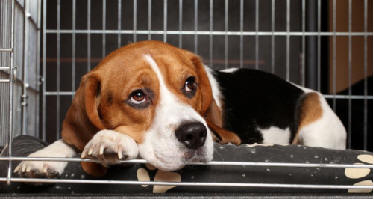 Use treats
Your goal is to make your dog associate the crate with positive
feelings, so encourage her to go to the crate by putting treats and
even food inside. Eventually she’ll see the crate as the place where
good things happen and won’t be as fearful.
Make it
comfy
Dogs love it when they can find a nice, comfortable place to sit or
lie down, so one of the best things you can do is to treat your
dog’s crate like it’s just another resting place. Place a favorite
blanket inside or buy a new one and leave the door open, so he can
come and go as he pleases.
Close the
door — briefly!
Obviously, the eventual goal with the crate is to be able to close
the door and still have your dog keep calm. Once you get to the
point where your pooch seems comfortable hanging out in the open
crate, offer some kind of distraction (perhaps a toy or treat) and
close the door while she is engaged.
Start with
intervals of five minutes or less and make sure you stay close by
and visible. Gradually keep it closed for longer periods and leave
the room so your dog can come to understand that she is still safe —
and will eventually get out — even if you’re not right there in
front of her.
Keep it up with these methods and most adult dogs will eventually come to accept a crate willingly. You may even discover that it becomes your dog’s new favorite place to sleep!
Basic Training Links
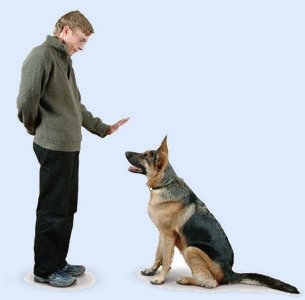 Free dog
training and obedience skills | Dog training and
obedience skills, outlined to help you train your dog the right way.
From simple commands to advanced training.
Free dog
training and obedience skills | Dog training and
obedience skills, outlined to help you train your dog the right way.
From simple commands to advanced training.
Obedience, puppy training & dog tricks | Most dog trainers agree that the secret to an obedient dog is consistency. This new style of dog training is achieved through positive reinforcement.
Whether you're a first-time pet owner or a seasoned one | A dog's frisky behavior can test your patience. Dog obedience training can curb bad behavior.
The following are the most common commands used by many dog training organization.
Heel - Dog to walk by your left side and the leash should be loose, dog not pulling.
Sit - Dog puts his butt on the ground assuming the "sitting" position.
Down - The dog puts their front legs down. They do not lay on their sides.
Come - Dog comes to you and sits or comes to the heel position if you want.
Sit-Stay - Dog sits and is then told to stay.
Down-Stay - Dog assumes the down position and is then told to stay.
Stay - The dog is to remain at the location they are at. The "Wait" command is also used by some before a dog would enter or leave a room.
Off - Get off people (don't jump up on people) or furniture.
NO - For any bad behavior and you may have to stop or correct the behavior.
Leave it - When you want the dog to drop the item or to leave it alone.
Place - Dog goes to their dog bed, crate or other location that is theirs.
Load up - When you want the dog to get into a vehicle.
Free - Lets the dog know that they can relax, potty, smell things or just lay down. Many dog trainers might use Take a Break instead of Free.
Out - Used by military &
police to stop the dog when they are attacking a person.
It could also be used for pets to release toy into your hand and
your had should be on the toy before giving the "Out" command.
Recommended Reading Links
 The
Dog Listener:
The
Dog Listener:
Learn How to Communicate with Your Dog for Willing Cooperation
In The Dog Listener Jan Fennell shares her revolutionary insight
into the canine world and its instinctive language that has enabled
her to bring even the most delinquent of dogs to heel. This
easy-to-follow guide draws on Jan's countless case histories of
problem dogs—from biters and barkers to bicycle chasers—to show how
you can bridge the language barrier that separates you from your
dog. This edition includes a new 30-Day Training Guide to further
incorporate Jan's powerful method into every element of pet
ownership, including: Understanding what it means to care for a dog
Choosing the right dog for you Introducing your dog to its new home
Overcoming separation anxiety Walking on a leash Dealing with
behavioral problems Grooming And much more
 Cesar's
Way:
Cesar's
Way:
The Natural everyday guide to understanding & Correcting Common Dog
Problems
From his appearances on The Oprah Winfrey Show to his roster of
celebrity clients to his reality television series, Cesar Millan is
America’s most sought-after dog-behavior expert. But Cesar is not a
trainer in the traditional sense—his expertise lies in his unique
ability to comprehend dog psychology. Tracing his own amazing
journey from a clay-walled farm in Mexico to the celebrity palaces
of Los Angeles, Cesar recounts how he learned what makes dogs tick.
In Cesar’s Way, he shares this wisdom, laying the groundwork for you
to have stronger, more satisfying relationships with your canine
companions.
NOTE: Contrary to any advice given in the books above, it is our belief that being a "Pack Leader" does NOT mean any form of domination, aggression, or making the dog fearful in any way. By simply understanding that dogs are instinctively social animal (just like us) and that they are willing to accept leadership the real goal should be to use their instincts as an aid in respectful, reward based training (i.e. behavior modification).
Top Of Page
|
© 2009 by Lake Haven. Lake Haven is a non-profit no-kill animal rescue shelter dedicated to the care and adoption of homeless and/or injured dogs, cats, kittens and puppies in the West Michigan area. Lake Haven is a recognized 510(c)3 organization that is 100% volunteer operated. |
 There are many situation where you can help your
adopted dog adjust effectively to its new surroundings. In addition
there may be some areas where you need to modify a dogs
behavior (i.e. jumping, house training, walking, etc.). These
pages contain information about many of the common questions we get
in these areas. In addition there are links at the end of this
page to other sites that provide training and behavior advise.
There are many situation where you can help your
adopted dog adjust effectively to its new surroundings. In addition
there may be some areas where you need to modify a dogs
behavior (i.e. jumping, house training, walking, etc.). These
pages contain information about many of the common questions we get
in these areas. In addition there are links at the end of this
page to other sites that provide training and behavior advise. The Walk
 To minimize bad behavior problems your dog needs
"something to do" that will provide mental stimulation, exercise,
and attentiveness. So, walk the dog for 30 minutes. Play ball with
him. Do some fun training. Take a training class. Teach your dog a
new trick. Run him up and down the stairs 20 times. If you can't
take your dog for an hour walk each day, then do it three times a
week. Or do something! You can't expect a dog, or a young puppy to
stay cooped up all day while you're at work and then lie by your
feet at night. If you can't make the commitment to properly own a
dog, then don't get a dog.
To minimize bad behavior problems your dog needs
"something to do" that will provide mental stimulation, exercise,
and attentiveness. So, walk the dog for 30 minutes. Play ball with
him. Do some fun training. Take a training class. Teach your dog a
new trick. Run him up and down the stairs 20 times. If you can't
take your dog for an hour walk each day, then do it three times a
week. Or do something! You can't expect a dog, or a young puppy to
stay cooped up all day while you're at work and then lie by your
feet at night. If you can't make the commitment to properly own a
dog, then don't get a dog. When getting ready to walk your dog, call the
dog to you, do not go to the dog to put the lead on. After the
dog comes to you make him or her sit calmly before snapping on
the lead or slipping on the collar. Retractable leashes are not
recommended, as they give the handler less control. The way you
leave your house and property is also important. Your dog has to
go out the door after you. If you put the leash on the dog and
or leave the house while the dog is excited and leading you, you
will be setting the mood for the rest of the walk to an excited
state.
When getting ready to walk your dog, call the
dog to you, do not go to the dog to put the lead on. After the
dog comes to you make him or her sit calmly before snapping on
the lead or slipping on the collar. Retractable leashes are not
recommended, as they give the handler less control. The way you
leave your house and property is also important. Your dog has to
go out the door after you. If you put the leash on the dog and
or leave the house while the dog is excited and leading you, you
will be setting the mood for the rest of the walk to an excited
state. The lead should be short and hang loose. If
the dog starts to pull, tug the lead up and to the side
throwing him off balance, then hold the lead loosely again (a
very quick tug, NOT a yank or jerk in any fashion). If the dog starts
getting too excited and you're not keeping him beside or behind
you, turn, go the opposite direction and stop (it's not
necessary when you are initially training your dog to walk
properly that he has to sit when ever you stop). Wait until he is calm than start
again. Do not call to the dog when you start walking again, just
start walking. The dog needs to learn he is following you, and
tune into the person walking the dog. Do not praise your dog for
walking calmly. This only creates excitement and you are more
likely to pull your dog out of his calm, submissive mind.
The lead should be short and hang loose. If
the dog starts to pull, tug the lead up and to the side
throwing him off balance, then hold the lead loosely again (a
very quick tug, NOT a yank or jerk in any fashion). If the dog starts
getting too excited and you're not keeping him beside or behind
you, turn, go the opposite direction and stop (it's not
necessary when you are initially training your dog to walk
properly that he has to sit when ever you stop). Wait until he is calm than start
again. Do not call to the dog when you start walking again, just
start walking. The dog needs to learn he is following you, and
tune into the person walking the dog. Do not praise your dog for
walking calmly. This only creates excitement and you are more
likely to pull your dog out of his calm, submissive mind.  If you pass a barking dog or other
distraction, keep moving forward. If your dog averts its
attention to the distraction, give a tug on the lead to avert
the attention back to the walk at hand. If the tug does not work
you can also use your foot, not to kick the dog, but to touch
him enough to snap his attention back on you. If you find the
dog pulling, stop and make the dog sit. Correct any excited
behavior over the distraction with a tug, and if that does not
work you can also use a firm touch to the neck using your hand
as a claw. Do this as soon as you see the dog starting to avert
his gaze toward the distraction, or as soon as you see a look in
your dog's eyes that tells you he is going to begin barking or
growling. Timing is everything. This must be done right before
the behavior happens or at the exact moment it starts. You do
not want to wait until it escalates. If you wait too long before
correcting a dog (were talking seconds), the dog may not even
hear you; he will be too focused on the distraction. When
correcting your dog, match your dogs intensity.
If you pass a barking dog or other
distraction, keep moving forward. If your dog averts its
attention to the distraction, give a tug on the lead to avert
the attention back to the walk at hand. If the tug does not work
you can also use your foot, not to kick the dog, but to touch
him enough to snap his attention back on you. If you find the
dog pulling, stop and make the dog sit. Correct any excited
behavior over the distraction with a tug, and if that does not
work you can also use a firm touch to the neck using your hand
as a claw. Do this as soon as you see the dog starting to avert
his gaze toward the distraction, or as soon as you see a look in
your dog's eyes that tells you he is going to begin barking or
growling. Timing is everything. This must be done right before
the behavior happens or at the exact moment it starts. You do
not want to wait until it escalates. If you wait too long before
correcting a dog (were talking seconds), the dog may not even
hear you; he will be too focused on the distraction. When
correcting your dog, match your dogs intensity. Dogs jumping up on people is at best an embarrassing, annoying
habit and at worst a danger for all involved. If you can't stand
your much loved dog jumping on you, just imagine what visitors to
your home must think?
Dogs jumping up on people is at best an embarrassing, annoying
habit and at worst a danger for all involved. If you can't stand
your much loved dog jumping on you, just imagine what visitors to
your home must think?  Before you read any further understand these
essential house training facts:
Before you read any further understand these
essential house training facts: